Now away to Runnymede where there occurred a significant historical deed!
‘On the fair field at Runnymede,
the barons would force John to rein in his terrible greed!’
The year 1214 saw the continuing conflict between John and Philip ‘de-esgusting’ Augustus. John had sought support among the English barons for an invasion of France, but found that interest was at best lukewarm. In the event, many of them sent their excuses and sat out the conflict this side of the Channel. Why?
‘ The smart money says that in any contest the French king!
Well, he’s simply gonna knock John, clean out of the ring!
But despite this, all was not entirely lost!
Events conspired to make John feel a trip to France was worth the cost!’
A number of French nobles had switched their allegiance from ‘Deesgusting Augustus’ to John, and this encouraged him to move against the French king. This caused John to be contemptuous of the English nobility. He announced:
‘ Hey you cowardly dogs, I have less faith in you than I do in my old hound, Rover!
You can wait, idly watching events in France from the white cliffs of Dover!
Until my destruction of ‘Deesgusting’ Augustus and his motley army is over!’
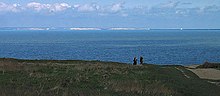
The White Cliffs of Dover as seen from France.
John landed in France at La Rochelle in February 1214.
Vauclair Castle, La Rochelle.

After an enthusiastic start, he was eventually out-manoeuvred by his French nemesis. In September, John signed an unsatisfactory truce with the French king. The military operation in France had proved to be an expensive flop that had drained the treasury. The nobility back in England were not sympathetic and on his return to England, he was taunted with:
‘It was absolute folly to go!
Didn’t we all gather here tell you so?
Now you know
That all it brought you was a load of aggro!’
John was determined to reassert his authority and recoup his financial losses from the war.
‘So what to do?’
What is the best idea in the king’s view!
‘I am going to tax each and every one of you!’
John was desperate to replenish his empty coffers. He decided to exact a scutage, an extra payment from the barons which greatly infuriated them. The spirit of rebellion permeated the fresh English air and many a baron threatened to break their oath of fealty to John. These barons insisted that the king grant them an official document or charter, that would guarantee them certain rights. They regarded John’s rule as one bordering on tyranny, and this they were resolved to stop. The king’s response was to attempt to marshal the clergy, with whom he was now reconciled, to his side against the nobles. John even petitioned the Pope, with whom he had long been in conflict with, to intervene in the dispute. Both sides prepared for conflict. After an inauspicious start, the rebel barons were in possession of London by May 1215. They besieged the Tower of London, whose garrison were still loyal to John, but the barons managed to gain possession of the royal treasury at Westminster. Additional rebellions broke out across England and the Welsh leader Llywelyn had invaded Shropshire.
Llywelyn the Great.

In the north, the King of Scots, Alexander II was granting aid to the rebels and all the time, ‘Deesgusting’ Augustus was encouraging the barons and lending them his support.
Seal of Alexander II of Scotland.

‘Opposition from north, east and west!
John was forced to give conflict a rest!’
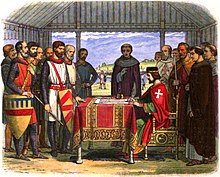
Finally in June 1215, the document known as the ‘Great Charter’ or ‘Magna Carta’ was presented to John at Runnymede.
King John signs Magna Carta at Runnymede in June 1215.
The underlying principle of the Charter was that the Crown was not above the law. One of the clauses bound the king not to levy any payments other than those which had been traditionally rendered. Another referred to the rights of all freemen under English law. The king agreed, and it appeared that the charter when signed, sealed and delivered had brought peace to England’s green and oft troubled lands.
The tedious ordeal of bureaucracy now over, the king and nobles then relaxed, smiled and all departed from the fair field at Runnymede with a feeling of some satisfaction. A stillness descended throughout the realm, but before long the sound of steel against steel would be heard once again.


