Author: John

The Final Years! Nothing for Henry but endless anguish, fears and tears!

The Final Years! Nothing for Henry but endless anguish, fears and tears!

Despite the formidable alliance arrayed against him, King Henry II would prevail.  A lesser man might have sued for peace but not the great-grandson of the Conqueror.  Henry conducted an extremely successful campaign, deploying an effective defensive strategy, decisively beating the Bretons and his nemesis, Louis, the King of France in the French theatre.  He skilfully defeated the opposition in England where the Scot, King William the Lion was attempting to expand his territory.

William I of Scotland

William the Lion

‘In England, the Scottish Lion decided that he would roam!

He wished to make the land of Northumbria part of his regal home!

His intentions were ignoble and foul!

Into battle, he led his men with a fearsome growl!

Captured at Alnwick by an English knight’s equestrian trick!

He was tied by the feet and dragged at the rear of a horse, enduring many a kick!’

The proud King of Scotland’s lofty ambitions would end in ignominious captivity.  The ‘Lion of Scotland’ was quite literally done with roaming; he was packed off over the channel to Henry’s castle at Falaise in Normandy where he was caged for five months.

The castle at Falaise.

Falaise chateau guillaume conquerant 2.jpg

Henry had won a momentous victory which established his hegemony across the continent. Although the rebellion was over, the brood were still brooding.

The eldest son, his father’s pride and joy!

Found that the life of a powerless king did fearfully cloy!

He demanded of his father what he thought was his by right!

He gathered his forces and proceeded to take up the fight!’

The eldest of the litter, young Henry, would simply not lie still and in 1183 got up on his hind legs to claw at his father once again. The ‘Young King’ rebelled again and during the course of his destructive tantrum, he plundered the rich shrine at Rocamadour.  The reason for this apparent sacrilege was not engendered by a desire to defile, but by the dire necessity to pay his mercenaries.  This being done, he then  then fell gravely ill with dysentery.

The shrine of the Black Virgin at Rocamadour.

Realising that death was near and thus his ambitions at an end, young Henry became racked with contrition and sent word to his father to come for one last visit of reconciliation. The young man requested that he be laid on a bed of ashes with stones laid at his head.

‘Ashes to ashes!

‘Dust to dust’!

This was the mark of the penitent, a stance that his father had himself adopted after the death of Thomas Beckett.  Young Henry felt that, given the considerably less than satisfactory circumstances, this was the only possible manner in which to greet his father.

Alas, the old king suspected a trap and declined his son’s invitation to visit, but nevertheless he sent him a sapphire ring once worn by his grandfather, Henry I as a sign of forgiveness.  Young Henry died on June 11th 1183 and by doing so he united his parents, the ill-matched Henry and Queen Eleanor.  They who had quarrelled fiercely for so very long, heartbroken and languishing a great distance apart, they were nonetheless totally united in an all-consuming grief at the death of their son.

The final days.

Henry’s problems with his sons were far from over. His unloved son, the treacherous Geoffrey was killed on August 19th 1186 in Paris aged twenty-seven.  The unfortunate prince had become unseated during a jousting tournament and was trampled to death underneath the hooves of the horses.

Knights Jousting.

There was speculation that Geoffrey was not in Paris solely for purposes of a sporting nature. It has been suggested that he was visiting the King of France, Philip Augustus with a view to hatching yet another plot against his father.  Geoffrey’s untimely passing appears to have engendered little, if any mourning at the the family home, Chateau  Chinon where life continued curiously uninterrupted.  Geoffrey’s wife would be delivered of a son some six months after the fateful tournament.

Then there were but two!

This of course left two sons, heirs legitimised by virtue of the the sanctity of marriage. These were the thirty-two year old accomplished warrior and proven ruler of Aquitaine, Richard and his younger brother, the callow inexperienced youth, John aged nineteen.

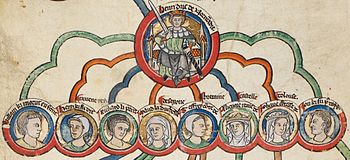
Henry and Eleanor’s children, as they were.

An illuminated diagram showing Henry II and the heads of his children; coloured lines connect the two to show the lineal descent

All of the boys died young and the youngest, John would live the longest.

Endgame

Despite his father’s efforts, Richard had not been rehabilitated after the debacle of the ‘Great Rebellion of 1173’ and there had been further trouble following the death of the ‘Young King, ‘ Henry .

Richard in familiar mode.

Richard I

It was now in 1189 that matters came to a head and the long saga of family feuding would come to a sad end.  With his older brother dead, Richard regarded himself as the sole heir to his father’s vast empire.  King Louis VII had also died and his son Philip Augustus had ascended to the throne of France.  The cast may have altered a little but the drama continued unabated. Richard now began to have reason to suspect that his father intended to disinherit him in favour of brother John. He was encouraged in this line of thinking by the King of France.  Philip wished to manipulate the family feud with a view to eventually incorporating the Angevin Empire into the kingdom of France.

Richard now demanded full acknowledgement of his rights as heir to the Angevin Empire but was rebuffed by Henry.  The son now decided on action and was enthusiastically supported by Philip.

Whilst having been stricken with sickness at his home town of Le Mans, Henry was faced with an attack from Richard aided by Philip.  In an attempt to counter their advance, Henry had the buildings outside of Le Mans set alight.  Unfortunately for Henry, at a most inopportune moment the wind changed, and the flames began to engulf the town itself.  Henry had no choice but to flee and from his vantage point on a nearby hill watched helplessly as his beloved birthplace was devoured by fire.

Already physically unwell, the episode at Le Mans had served to greatly undermine his emotional state and Henry agreed to a parley at Tours.  Here the old king, so sick that he could scarcely stand, met with his son for the last time. It was hardly a joyous reunion and Henry did not conceal his feelings of resentment towards Richard.  Nevertheless, he conceded all of his son’s demands albeit through gritted teeth.

His strength rapidly slipping, his mind shrouded in sorrow and harbouring notions of vengeance, Henry retreated to his sanctuary at Chinon. There in its hallowed halls, Henry lay supine and took stock of this veritable wheel of misfortune which had trapped him in a ghastly circle of unimaginable misery.  Perhaps he comforted himself with the thought that no further ill could possibly befall him. However, in this he was mistaken.


Here in his darkest hour he learnt that his youngest and favourite son, John had also deserted him. This would prove to be the cruellest and quite likely the mortal blow. The old king turned his face to the wall and uttered:

‘I care no longer for myself or anything else in this world.’

Henry would die on July 6th 1189 aged 56.  He was buried at the Abbey of Fontevrault close to Chinon where Eleanor and Richard would later join him.

Henry II

Family fortunes and unfortunate families!

Family fortunes and unfortunate families!


‘Bringing it all back home!

‘Tis back to Chinon, we, as a family will always roam,

Therein lies the threat to my hard won throne!

For here in Chinon, from my seat of power, I might well be thrown!’

Thus spake King Henry, with a most heartfelt groan!’ 

 Henry ruled an empire which stretched from the Pyrennes in the south to Cumbria in the north and latterly to Ireland in the west.  An able ruler, Henry governed these lands in an efficient manner and successfully protected his borders from invaders.  However, home is where the heart is, and Henry’s lay at his beloved Chateau, Chinon in France.

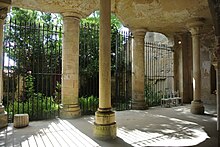
Sainte Radegonde chapel, Chinon.

It would be quarrels of a domestic nature that would thwart Henry’s hopes and which would bring him years of exhausting warfare, including the destruction of his beloved birthplace, the city of Le Mans, shameful capitulation and a sad lonely death, deserted and betrayed by both his wife and his dysfunctional brood of heirs.

‘Good at coping with the threats from outside!

Rather less so in dealing with the dangers from the inside!

Their time, his treacherous sons would bide’!

He had been a fine monarch and father and would bequeath his sons a rich inheritance!

The source of this intolerable sorrow was Henry’s decision to divide his sprawling empire amongst his sons.  Like the talented corporate manager that he was, Henry laid his plans for the future in good time and with mathematical precision.

Henry’s sons numbered four.  Henry, the eldest would receive the jewels in the crown, England, Normandy and Anjou.  Richard would receive  his mother’s birthplace of Aquitaine, befitting as he was her favourite son.  Geoffrey would be granted Brittany; and John, the newly acquired lands in eastern lreland.  Very much a mixed bundle of packages, but a collection which reflected medieval custom and protocol.

Decision! Precision! Perdition!

The eldest was Henry, perhaps the sibling most dear to his father’s heart, but he would die young as would the third son of the ‘devil’s brood’, Geoffrey.  The second son Richard, his mother Eleanor’s favourite, and formidable soldier who would eventually inherit his father’s empire. The youngest, John ‘Lackland’ so called as he inherited none to speak of from Henry at first.  He too would eventually become ruler of the Angevin empire through the deaths of his brothers. Unfortunately it was ‘easy come, too easy go’ as he would lose his father’s hard held lands!  John went from John Lackland  to John Loads of land and eventually,  John Lose-land! A King’s ransom was lost in the East Anglia sand!

‘Henry had been a good king ,

he expected that of his praises, his sons would sing!

No such thing!

These ungrateful boys were only concerned with the riches

that the end of their father’s reign, to them, would bring!’

Mum’s the word!  M’mm!  Mum ?

That was the problem!

Eleanor of Aquitaine was Henry’s wife and apart from the sons, she also  gave him an awful lot of strife!  The fresco below, which dates from the 12th century, depicts a number of figures , two of whom are crowned and one, a woman who has red hair.  Eleanor was renowned for her mane of golden hair, the hue of which was a fiery red. This was, as it is said, a perfect match for her temperament.

The fresco in Sainte Radegonde chapel, Chinon.

Henry, eldest son of Henry II

Henry’s plan for bequeathing his vast European empire to his brood  engendered a thoroughly unfortunate bout of teenage rebelliousness.  In 1170, Henry had taken the highly unusual step of crowning his eldest son, the sixteen year old Henry as King of England.  He did this because he wished to ensure that there would be no doubt concerning  the succession after he had died. However, Henry took the precaution of keeping all regal authority in his own hands.  In this way, the teenager could ease himself into the job by serving an apprenticeship which would allow him to craft the skills necessary to take up the reins of kingship when the time came.  However, the ungrateful youth saw things somewhat differently. He wanted the power of the throne with immediate effect.  When Henry decided to hand three of young Henry’s castles to the youngest sibling, John, the youth fell into a fury.

In 1173 the young colt deserted the old warhorse and with his loathsome brother, Geoffrey,  galloped to the stable of his father-in-law, the French king, Louis VII.  There he found a sympathetic ear as he vented his spleen about his father.  Louis had once been married to Henry’s mother, Elanor of Aquitaine.  Louis’s words of sympathy masked a mind preoccupied with self-interest.  Louis encouraged the young king to mount a rebellion against his father.

Louis VII of France on his marriage to Eleanor of Aquitaine.

Fourteenth century depiction of the marriage of King Louis VII and Eleanor of Aquitaine. The image on the right shows Louis leaving for the Second Crusade.

There were others who were only too pleased to assist the young man in this unworthy endeavour.  His brother, the formidable Richard, King William the Lion of Scotland, assorted barons as well as the King of France lined up to march under young Henry’s banner against his father. Even his mother, the redoubtable Eleanor slipped out of house arrest in an attempt to offer her son moral support against his father.  The ‘Great Rebellion of 1173’ had begun.

Henry Expands the Angevin Empire

Henry Expands the Angevin Empire

Strongbow! You are now on your way west!

Ensure that your actions are characterised by the utmost zest!


Henry had been happy for Strongbow to go to Ireland and had wished him every success. The problem was, Strongbow had been too successful.  Would Strongbow now establish a kingdom which could rival and threaten his kingdom of England?  Henry decided to nip any such emerging problem in the bud.

The King feared that the seeds of trouble, Strongbow would sow!

Henry would now act to prevent the emergence of any potential foe!

There was no choice, to Erin’s fair shores he must now go!


However Henry would have to persuade his barons that a foray to Ireland was a good idea.

Henry makes his nobles an offer that they cannot refuse!

He will tell them that they have everything to win, nothing to lose!’


He gathered them together for a sit down and banquet at Chinon in Normandy.  After a superb dinner of locally sourced venison, Henry made his pitch.  In doing so, he evoked the memory of their respective great-grandfathers. The dialogue probably went along these lines:

‘My proposition to you is the same as my great grand father, William the Conqueror, made to your great-grandfathers here in Normandy about invading England in 1066!

After giving him a hand at that skirmish over there at Hastings they were handed a real estate portfolio that surpassed their wildest dreams!

I propose that we deal with the Irish in the same way that our great-grandfathers dealt with the English! We win a battle, after which we erect a motte and bailey castle, and then move on to the next Irish tough guy!

There were murmurs!

‘Sire, those Irish are known to be savage beyond belief!’

Another:

‘Even the Romans left them alone’!

Yet another:

They are rumoured to be man-eaters!’

Henry put down his goblet, wiped his mouth, rose to his feet and made his announcement.

‘If your great-grandfathers had that attitude in 1066, you guys would still be hustling geese and onions in the mean streets around the market at Caen rather than lording it in your castles over in England!

I’m offering you and your families the best career opportunity in over a century!

If your answer is no!

You really don’t want to know!

Maybe! Maybe, you’re right! It ain’t the way to go!

I can talk to someone else!

I have some Sicilian friends, of Norman descent, and when they smell wealth the word fear disappears from their lexicon!

I hear that Palermo is a little hot and overcrowded at this time of year’

‘Perhaps those Sicilian guys might feel the urge to relocate!

Should they wish to…

In that case some Irish territory, to them, I might well  allocate!’

The barons decided to follow their monarch. The king now made plans for a trip west.  A formidable military force was assembled and Henry landed at Waterford in October of 1171.

Henry landing in Waterford, October 18th 1171.

As their great-grandfathers had done a century earlier against the English, the Anglo-Normans would defeat the Irish tribes in battle and then construct a motte and bailey castle. When the local clan chief had been pacified by whatever means necessary,  the Anglo- Normans would divide the best land amongst his followers. There was no shortage of takers from England. Real estate opportunities were hard to come by during that time, and many were only too happy to make the journey to the ports of Bristol and Chester to travel to Ireland.

The long and troubled relationship between the two countries had begun.

A motte and bailey castle.

Motte and Bailey Castle

Ireland! The English Crown’s first and last colony! The thorn in the Crown?

Ireland! The English Crown’s first and last colony! The thorn in the Crown?


Ancient Irish Brooch

Illustration of an ancient Irish brooch.


The year of 1171

did not bring Henry a huge amount of fun!

Although the new year of 1171 was one that did not start at all well for Henry,  it proved to be a time that was one of the most important of his reign.  Beckett’s death had made the great palaces of France and England a little less welcoming than hitherto.  At mass, the priest would cast him brief, but intensely resentful glances.  During special ceremonies the bishops would huddle together, muttering amongst themselves whilst glaring at him from behind their croziers; then falling strangely and totally silent when he came close, their heads bowed as if deep in prayer.

The atmosphere was oppressive and Henry felt that he had to get away from the miasma of resentment and latent hostility which permeated his royal domains.  The master of his vast territories? He felt like a trespasser when dwelling in his many palaces, he simply had to flee!

I simply have to flee! Yes flee!

Can ye not see?

It is elsewhere, anywhere, I must be!

Ironically it was actually the Church which provided him with the perfect avenue with which to do so.

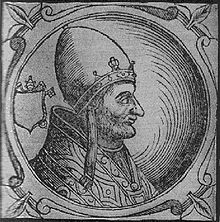
Pope Adrian IV.

Pope Hadrian IV.jpg

The Vatican had long been expressing concern about the state of the Church in Ireland.  Pope Adrian, the only English Pope, had wanted Henry to launch a crusade to Ireland way back in 1155.  The Pope is said to  have sent the young King this papal bull in which he encouraged Henry to go to Ireland.

Thou hast signified to us, indeed most beloved son in Christ, that thou’s dost desire to enter into the island of Ireland, in order to subject the people to the laws and to extirpate the vices that have there taken root…’


The young Henry would have  been only too happy to comply with the Pope’s wishes but his mother, the formidable Matilda still exerted considerable influence over her  son and she effectively vetoed the idea.  MUM’S THE WORD! The proposal was shelved.

Then something occurred that put the matter back on the agenda.

In 1166, Dermot MacMurragh had been deposed as king of Leinster by the High King, Rory O’Connor.  Dermot fled to the court of Henry II with a view for asking for assistance in regaining his kingdom.  At this point Henry was somewhat indifferent to events in Ireland but he allowed Dermot to recruit mercenaries and encouraged his people to aid Dermot.  In return for this help, Dermot agreed to swear an oath of loyalty to Henry.


Dermot swears fealty to Henry II.

‘Tis amazing what you can achieve by swearing loyalty to royalty!

At King Henry’s feet I did kneel!

A firm promise, the King and I did seal!

King Henry offered me a very good deal!

Rory O’Connor, with you, I am going to get real!

A number of Welsh-Norman noblemen offered to help Dermot in his endeavour; prominent among these was Richard de Clare, the earl of Pembroke also known as Strongbow.  Dermot had offered Strongbow a deal whereby  in exchange for his help, Dermot would give his daughter, Aife in marriage to the nobleman and name him his heir as king of Leinster.  Strongbow leapt at the offer. In 1170, Dermot and Strongbow had a number of military successes and they had indeed regained control of Leinster.  In May 1171 Dermot died, and Strongbow, in a blatant breach of Irish hereditary custom, declared himself King of Leinster.

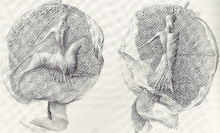
Seal of Richard de Clare, Strongbow.

Richard de Clare "Strongbow" (seal).png

Henry, watching events from Normandy, took the view that Strongbow was attempting to establish a rival Norman kingdom in Ireland that could pose a threat to his English realm. The King concluded that it was now time for Ireland to receive it’s first royal visit from the English crown, whose King was actually a Frenchman. Why not, he even had a papal blessing to do so!


Murder in the Cathedral

Murder in the Cathedral

Twelve  merry fun-filled Christmas nights?

No!  Four very well-armed, murderous knights!

Some items of the knights hand luggage on their journey from Calais to Dover.

Intricate dagger with clipping path

The four knights who took it upon themselves to travel to Canterbury that fateful Christmas were:Richard Brito, William de Traci, Reginald fitzeUrse and Hugh of Morville. They were devoted to Henry and his hurt was their hurt.  These men were intent on making Beckett an offer that he could not possibly refuse!

‘An offer from the king that I can’t possibly refuse?

In my position as Archbishop, I have absolutely nothing left to lose’!

( Thomas Beckett).


They would attempt to persuade Beckett to withdraw the writs of excommunication that he had issued upon the bishops loyal to Henry.

The Archbishop must submit to our gracious sovereign’s will!

If not, we will have no choice but to go in for the kill!

Thomas Becket

These men were angry!  They had had to leave the comfort of the royal palace at the height of the festive season and travel the sea in the middle of winter!  The copious amounts of food and drink that they had consumed at the Christmas celebrations would almost certainly have ended up adorning the waves of the English Channel, as the currents swung their little ship to and fro, making them impossibly ill with sea sickness.

As the night sky was filled with the sound of thunder

More than one Norman knight did violently chunder!

However, the experience could not have served to cool their hostility to the errant Archbishop.

‘For this sickening  inconvenience, Beckett is going to pay! 

And almost certainly before this coming New Year’s Day’!

The knights arrived at Canterbury on December 29th and it appears that their arrival in the city did not come as a total  surprise. The clerics urged Beckett to flee, but the Archbishop rejected their heartfelt pleas and resolved to stand his ground on the flagstones of the Cathedral.

Beckett stood unflinchingly as the knights came into his presence. His stance clearly conveying an uncompromising defiance in the face of a superior, malignant force.  After an acrimonious exchange, fitzurse moved forward and struck a blow to Beckett’s head. His companions also unsheathed their swords and the Archbishop was brutally and swiftly slain, his brains flowing across the Cathedral floor.

A scene depicting the manner of Beckett’s death.

‘His great intellect now but mere grey matter flowing across the sacred floor!

The four assassins turned on their heels and marched out through the Cathedral door!

Leaving behind them, a scene of unimaginable gore’!

All Christendom shuddered.  Henry retreated into a stupor of total shock. Whatever Henry may have said about Beckett at the Christmas festivities in Normandy, he was distraught with grief when he learnt of the Archbishop’s death. The king claimed that the words uttered that fateful Christmas night were not meant as orders to harm the Archbishop. Nevertheless he would be held responsible for Beckett’s death.

In order to receive absolution!

Henry would have to accept retribution!

Ouch!

Henry agreed to the Pope’s demand to modify the Constitutions of Clarendon in the Church’s favour.

Ouch! Ouch! Ouch!

At Thomas Beckett’s tomb, your majesty, you gotta crouch!

In August of 1172 Henry did penance by walking barefoot to Beckett’s tomb in the Cathedral where he had been slain while monks whipped his bare back. Only then did Pope Alexander grant Henry absolution for the horrific act.

The king must be scourged!

If his heinous sin is to be purged!

Thomas Becket


Very soon, Beckett’s tomb became a place of pilgrimage for Christians who claimed that miracles had occurred there. For almost four hundred years, pilgrims  would visit and leave objects of value as offerings  to St Thomas, ‘God’s holy martyr’.  In the sixteenth century another king Henry, the eighth of that name would desecrate and close the shrine and rob it of the huge amount of valuables so piously offered by so many pilgrims.

Henry VIII.

Henry VIII

All he does is stand and smile!

After performing an act at Canterbury so mean and vile!


A Royal Christmas – The Plantagenet’s celebrate

A Royal Christmas – The Plantagenet’s celebrate

The King and his court come together to celebrate Christmas and New Year!

But for Henry, later events would cause him to shed many a tear!


It was Christmas 1170 and Henry was taking stock of the year. The twelve days of this feast would have been a truly sumptuous affair. He celebrated with his Queen, Eleanor of Aquitaine, who had once been married to the King of France, Louis VII.  Eleanor, who was a woman of great passion, once remarked of Louis that she had’ not married a King but a monk’.  Her second husband Henry, was certainly no monk.  The King, Eleanor and the princes and princesses were all together for the festivities.

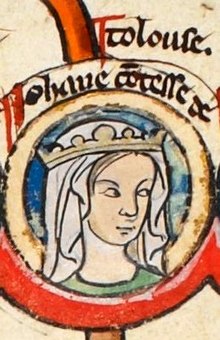
Eleanor of Aquitaine (1122-1204)

During the feast, endless courses of venison and fowl and other delicacies were consumed with relish.  The quality of the various wines was exquisite, and were drunk by the barrel as the court watched the entertainment.

However, King Henry was annoyed at the conduct of the Archbishop of Canterbury whom he had appointed. The king and the Archbishop, Thomas Beckett (Tom Becs) had now seriously fallen out.


We cannot be entirely sure as to how Henry was actually thinking, but it could not have been too far from what is recounted below.

‘Not a bad year I suppose! I got my boy, my pride and joy, Henry crowned as junior king in May. The only trouble was that I had to get him crowned by that kindly old duffer, Roger, Archbishop of York. Of course it should have been the Archbishop of Canterbury, Tom Becs but he had been nowhere near the Cathedral in years! The old hound was sulking and  licking his wounds in France and snarling at anyone that he came across who was loyal to me.

The Pope has made me take him back and now he is prowling around the Cathedral grounds, cantankerous as a bear with an arrow shot through his vitals!  Anyway let’s just enjoy Christmas and here’s to 1171!

The royal princes, especially Henry and Richard, would have been soaking up the atmosphere as they watched the clowns and tumblers perform in the colourfully decorated surroundings. The tunes flowed forth from the instruments played by the musicians and everyone ate, drank and made merry.

The minstrels in the gallery

Image result for medieval minstrels To the Christmas festivities, we have all made a start!

Now, let us all watch Roland take the major  part!

The highlight of the banquet was provided by a jester, one Roland le Fartere, whose prime duty was to provide the diners with an unusual entertainment in the form of a jump, whistle and then a breaking of  anal wind. It has to be remembered that it was the custom for the royal party to be served their dinner first. So Henry would have finished eating when Roland began his act but his courtiers were still at work with their meal.

Roland would leap around the Great Hall whistling and breaking wind as the courtiers enjoyed the wonderful cuisine However, the courtiers were less than impressed. The odours of his innards mingling with the aroma of the vast amounts meats and spices served.  The guests, some of the royal entourage must have felt a little nonplussed at this particular performance. Nevertheless Henry enjoyed Roland’s performance so much, that in return for this service he had given Roland a manor of 30 acres in Suffolk for a mere 12 nights work every Christmas.

‘Roland gleefully let loose his load of bowel perfume!

Twisting the nostrils of all and sundry in the room!

For simply making an almighty smell,

Didn’t Roland do incredibly well!’

The King was laughing so heartily that he could barely lift his head from the table, tears of absolute mirth streaming down his cheeks as he watched his guests recoiling in disgust as they attempted to eat their dinner. The king’s very sides were almost splitting as he, seated above and well away from the performance, surveyed the festive scene. Henry was merrily banging his fists down in sheer delight, he had never been more happy. Then something happened that stopped the festive merriment dead in its tracks.

Despite the huge amounts of Christmas booze ,

there then came news 

which would give Henry a bad dose of the blues!

Amidst all the carousing and and general hilarity came a group of men whose solemn expressions left any onlooker in no doubt that they were clearly in no mood to celebrate anything. They were bishops from England who had come to tell Henry about Beckett’s actions.

The King was furious and began ranting and raving about the ingratitude of the court!  He had given them all so much but they allowed him to be insulted ,

‘By a lowly born clerk’!

The guy’s a real 100%  jerk!

Well we all know where this renegade does lurk?

He is reputed to have said:

‘Will no one rid me of this turbulent priest’.

He’s an absolute, total unruly beast!

Tom Bec’s has ruined a most enjoyable Christmas feast!

There were four Knights present who, when they heard these words, quietly slipped away and began to pack for the journey across the channel to Canterbury. Their baggage was heavy! Very heavy!

The patience of a saint? Henry, you pretty much had it!

The patience of a saint? Henry, you pretty much had it!

In order to rebuild the fabric of the English nation!

Henry needed to restructure the country’s administration!

Henry was the sovereign of a sprawling empire which stretched from the Pyrenees in the south, to Cumbria in the north and later to the Shannon in the west.  Nevertheless, his initial priorities lay in England. The king  now had to restructure the government of England after the years of upheaval under Stephen.  Henry would build on the solid foundations laid by his grandfather, and of course in this endeavour, it was important to have men of talent at hand.

A man of great thought and reason!

In short, a man for each and every season!

When Henry was looking for a suitable person for the chancellorship, Archbishop Theobold recommended his assistant, one Thomas Beckett.  A flamboyant character, but an immensely able man who in modern parlance, would be described as a ‘problem solver, par excellence’.  Thomas proved himself to be an indispensable servant to the king and despite Thomas being fifteen year’s Henry’s senior, the two men became close friends.

Thomas Beckett.

In 1162, Henry appointed his friend as Archbishop of Canterbury. However a dispute soon arose which would destroy their friendship and have truly fatal consequences. In medieval times, the Church were allowed to try  clergy accused of breaking the law in their own courts rather in the king’s courts.  This often resulted in priests and others who worked for the Church, receiving much more lenient punishments than they would had they been tried in the King’s courts.  Indeed the king was told of clergymen committing serious felonies such as rape and murder. However their punishments had been extraordinarily mild. Henry was enraged at what he regarded as a dreadful case of double standards and demanded that any member of the clergy found guilty of an offence be subject to the same penalties as ordinary people.

If a priest is caught!

He shall be dealt with in the same way as an ordinary person in the King’s court!

To Henry’s great surprise and anger, Thomas disagreed, and stated that the king had no right to interfere in the affairs of the Church. In 1164 a council of clergy approved Henry’s position in a document, the Constitutions of Clarendon. The Constitutions of Clarendon stated that:

‘The ordinary criminal suffers amputation, mutilation 

and public humiliation’!

‘For too long the monkish rogue has suffered only a mild inconvenience and aggravation’! 

A bitter dispute developed because Beckett eventually refused to accept the document and he was forced to flee to France in 1165. Under pressure from Pope Alexander, Henry allowed Beckett to return in 1170 and it appeared that perhaps the quarrel could be put to rest.

Pope Alexander III (died 1189).

TrioE.jpg

Instead it stoked the flames of their deep disagreement to an unimaginable degree.  While Beckett had been in France, Henry had had his eldest son crowned junior King of England.  Due to Beckett’s exile in France, Henry had Roger, Archbishop of York officiate at the coronation ceremony.  Beckett was furious, this task had always been the preserve of the Archbishop of Canterbury since time immemorial.

The coronation of Henry’s son.


Thomas said that the coronation of a King was the prerogative of the Archbishop of Canterbury and no one else. In his view the king had had no right to allow the Archbishop of York to crown his son. Beckett promptly excommunicated the Archbishop of York, and two other bishops. This was an act which he knew would enrage the king.

The die was now set, and somebody would have to die!


Henry II

Henry II

The Plantagenets.

‘From the devil they came and unto the devil they shall return!’

(A cleric commenting on the Plantagenets.)

When Matilda married Geoffrey of Anjou in 1128, neither of them could  have foreseen that their stormy union would produce a dynasty that would rule England for 331 years.  The dominance of this family which began 1154 with the coronation of their son, Henry, would only end with the death of Richard III at Bosworth field in 1485.


Richard III

Richard III earliest surviving portrait.jpg

The dynastic name derives from Henry’s father, Geoffrey, whose heraldic symbol of a sprig of yellow bloom was known in Latin as planta genista.  The family’s hegemony would see the conquest of Ireland and Wales and the loss of the Angevin empire in France. The dynasty would produce some crusader princes and some great lawmakers. A number of the brood, notably Richard I and Edward I would distinguish themselves as great warrior kings who crowned themselves in military glory.

Richard I                                                               Edward I

Richard IA man in half figure with short, curly hair and a hint of beard is facing left. He wears a coronet and holds a sceptre in his right hand. He has a blue robe over a red tunic, and his hands are covered by white, embroidered gloves. His left hand seems to be pointing left, to something outside the picture.                                Edward I  Others such as John I and Edward II , their reputations in tatters, would die in disgrace mourned by very few people. Two monarchs were destined to die on the battlefield, and another two would be secretly put to death in a dark, dank, castle dungeon. The rest would die in bed, including one who was murdered in the comfort of his four poster in the Tower.

Henry! The first Plantagenet king!

At his coronation, the Abbey’s bells did ring!

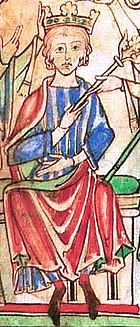
Henry II was crowned by Archbishop Theobold on December 7th 1154 in Westminster Abbey.  At twenty one, he was a powerfully built young man with lively grey eyes and a demeanour which exuded a restless energy.  An energy which would be used to extremely good effect over the next thirty-five years.

Henry II

Henry II

‘Cometh the hour, cometh the man’.

Indeed after almost twenty years of anarchy, the country needed an energetic man of ability and forceful character, and they got him. In many respects the second Henry resembled the first. He possessed his grandfather’s determination,  administrative abilities and also his sharp political  antennae.

Illegitimate baronial authority, I will abolish!

Your illegally built castles, you must demolish!

The young King’s first priority was to re-establish the royal authority which had evaporated in many areas under the weak, chaotic  rule of Stephen. Early in his reign, Henry made it clear to the barons that they had to demolish the castles they had built without royal permission. With one notable exception, that of Hugh de Mortimer in Bridgnorth, this objective was achieved quite quickly.

Square keep castle of the type common in the 12th century.

England was not Henry’s sole concern. He was the lord of vast areas of western France. His many French  territories included Aquitaine, Brittany, and Normandy for which he did homage to the king of France.

In 1152 Henry married Eleanor of Aquitaine who had formerly been the wife of his nominal overlord, king Louis VII of France. Like his father he had married a woman considerably older than himself. Eleanor was eleven years Henry’s senior.

Eleanor of Aquitaine (1122-1204)

Eleanor of Aquitaine

In 1157, Richard, the first of five sons was born. It is ironic that his sons gave Henry more trouble than all of the opponents that he had encountered in the course of his long reign combined. However, that was in the future, so the early years of his reign appeared to be auspicious enough. After the chaos of the previous twenty years, Henry had restored order in England.


You know Steve, you really should have passed on that offer!

You know Steve, you really should have passed on that offer!

The reign of King Stephen (1135-1154).

Stephen

The barons had made a solemn oath to Henry that they would recognise his daughter, Matilda as their sovereign monarch after his death.  However once Henry was dead, they made it clear what they really thought about putting a woman on the throne.

Matilda depicted in a stain glass window.

26

‘Waltzing Matilda?  She can go dance!’

A number of England’s most powerful barons would not countenance the prospect of being ruled by a woman and offered the crown to Matilda’s cousin, Stephen of Blois.  Stephen was a grandson of the Conqueror and was the only legitimate male available for the top job. Stephen was crowned on December 22nd 1135 and at first his position appeared secure, as the majority of the nobility supported his claim to the throne.

As far as they were concerned there was simply no alternative to Stephen, even Matilda’s half brother, Robert of Gloucester swore fealty to Stephen at his coronation.  All of this was too much for the haughty, combative Matilda and soon England was engulfed in a terrible civil war.

Double cross!

No matter!  I’ll show them who’s boss!

Matilda landed in Sussex in 1139  supported by her uncle David I of Scotland and now by Robert of Gloucester who had decided to switch sides.  Like many English magnates, Robert had become totally disenchanted with Stephen’s rule.  They had come to the conclusion that Stephen did not possess the qualities needed to rule a kingdom.  He was simply unable to impose his authority and had a tendency to treat opponents rather too leniently.  This cost him the respect and ultimately the support of his allies.

The country was devastated by the fighting and it was said that:  ‘Christ and his saints slept’.  In February 1141, Matilda defeated and captured Stephen at the battle of Lincoln, and it looked as if Stephen’s reign was now at an end.

BUT!

Another Matilda, Stephen’s wife, now entered the fray and managed to capture Robert of Gloucester!

I’ll swap you your brother for my husband’.

This led to Stephen going back on the offensive, and in the winter of 1142 he looked as if he would get his revenge for his humiliating captivity when he cornered Matilda in a siege at Oxford castle. It was snowing, and the ever resourceful Matilda dressed herself in snow white garments and slipped out of the castle unnoticed through Stephen’s lines.

Matilda at Oxford CC

The war ground to a horrible, stagnant stalemate with Matilda in control of the south-west and Stephen dominating the south-east. Neither side was able to dislodge the other.  This was compounded by the fact that Matilda had made herself unpopular through her haughty manner and it was now generally recognised that Stephen was totally unsuited for kingship.  In short, neither commanded any enthusiastic support in the country.

What a lousy choice!

Either way, we the people have no voice!

In this situation some kind of compromise had to be agreed and eventually it was. By now Matilda’s son, Henry, was playing a dominant role in the campaign and in 1153 he and Stephen reached an accord, the Treaty of Wallingford. It was agreed that Stephen should stay on the throne for life but Henry was to be his heir. Stephen died a year later.

Triumph and Tragedy 1106-1135

Triumph and Tragedy 1106-1135

Triumph.

The Battle of Tinchbrai!

Henry wins the day!

Henry had bribed neighbouring princes to take his side and the tactic certainly paid off. It appears that the forces from Maine made a substantial contribution to his victory at Tinchbrai. Robert, the hero of Ascalon and who had been present at the capture of Jerusalem had fought his last battle.  The eldest son of the Conqueror was captured and immediately imprisoned by kid brother Henry. Robert would remain incarcerated in Wales until his death in 1134. Robert had always been known for his energy and captivity did little to extinguish it. The former Duke, upbeat as always spent his comfortable, lengthy confinement learning Welsh and composing poetry. Robert was at least eighty when he died, an incredible feat at a time when most people died before the age of forty.

Henry had won a magnificent victory, he was now his father’s equal as Duke of Normandy and King of England.

Modern day Tinchbrai.

Tinchebray 01.jpg


Robert Curthose’s tomb in Gloucester Cathedral.


GetIn his lifetime, Henry was known as the ‘Lion of Justice’.  Royal justices were sent out into the shires to ensure that justice was being done in the shire courts.  Those found guilty were treated very harshly indeed.

Tragedy.

Henry’s son, William the Atheling.

William the Atheling

Although he had many illegitimate children, Henry had but one legitimate son who could succeed him. This was William, who from an early age had accompanied his father on his campaigns in France against the king of France. Contemporary chroniclers comment on William’s generosity and sweetness of nature and this is borne out by an incident in France.

Robert Curthose’s son, William Cilito was fighting against Henry on the side of the king of France in order to take back his father’s duchy. During the battle, Henry’s son, William Adelin lost his horse along with its valuable equipment. In a most chivalrous gesture William Cilito returned his cousin’s horse to him the very next day.

A figure that may have been Curthose’s son, William Cilito but a shortage of leg length is not in evidence.

William Clito

Henry’s later years were troubling ones. Matilda had died in 1118 and in 1120 he received a blow from which he never really recovered.

It is a terrible shame that you took that trip

aboard the king’s swift White Ship

On November 25th 1120, William with a number of family members boarded the the King’s vessel, at Berfleur  for the journey back to England. The crew had been drinking and the ship crashed into a rock in the bay and began to sink. William managed to climb aboard a small boat but when he heard his half-sister, Matilda Fitzroy, Countess of Perche calling from the ship, he turned the boat back in a valiant  attempt to rescue her. However the boat was overturned by the waves and William was drowned.

A medieval illustration of the sinking of the White Ship.

WhiteShipSinking.jpg

Henry was inconsolable, he had not only lost a son but also his heir. This presented Henry with a crisis of succession, he had to have an heir to the throne. In 1121 he married Adeliza of Louvain who was some 35 years his junior in an attempt to conceive a male child. However the marriage was childless and Henry decided the only option, albeit a tricky one, was for him to appoint his daughter the recently widowed Matilda as his heir.

The king knew only too well that there had never been a Queen of England but resourceful and resolute as ever, Henry decided to try what he must have known was an almost impossible task. At Christmas 1126, the king summoned the leading barons to Westminster and called on them to pay homage to Matilda as his heir to the crown. Of course they gave their assurances that they would be loyal to Matilda but Henry undoubtedly saw the glow of avarice illuminating their smiling visages as they sampled the mulled wine. It could hardly have been a merry Christmas for the ageing monarch.

The King asked for his favourite fish dish!

‘A lamprey eel! A lamprey eel!

my favourite, but by God how ill it made me feel!’.


A lamprey is a type of  eel.

Jõesilmud2.jpg

Henry I died of food poisoning on December 1st 1135 and is buried in Reading Abbey. The  political career of Henry, given the context of his place in the hereditary line was an undoubted success. This of course was due to a combination of both good fortune and his own astute calculation. However his death at a fairly ripe old age could hardly have been a happy one. A king was expected to leave a male heir and he left but a daughter, Matilda. An immensely shrewd man he undoubtedly foresaw the dreadful chaos that would befall England once he was dead and despite his most earnest efforts to prevent the calamity, it did.

T

Henry-I-3-06355d4

Such, such were the joys!

Henry was the last of King Billy’s boys!