Author: John

William the Conqueror.

William the Conqueror.

The Tower of London, which was built by William the Conqueror.  The Tower was the very first stone castle to be built in England. To this day it remains in use as an official royal residence and national armoury.

Why the English people remained loyal to those who were born royal!


Never again would England’s southern shore, to an invader offer an open door!


One most unlikely to succeed!  Who could have foreseen his ingenuity, military prowess and greed!

It all began across the English Channel in France, with the birth of a baby boy who was not of royal blood.  Indeed, William the Conqueror as he would eventually become known, was born out of wedlock in c.1027 at Falaise in Normandy.  The son of Robert the Magnificent  Duke of Normandy, and Herleva of Falaise.

No single man would have more influence on the language,  legal system and social structure of England than William of Normandy.  He also proved to be an immensely able soldier, but when he invaded England, his military capabilities were aided by extremely fortunate circumstances that no one could have foreseen.  One of these involved the weather, which at the time,  frustrated William beyond measure but later would prove to be a decisive factor in his  eventual success. The  second fortunate element was the ambitions of a potential competitor for the English throne whose actions would serve to benefit William rather than himself. Both of these events will be examined and explained later in the blog. So please pay me another visit!

What did this guy look like?

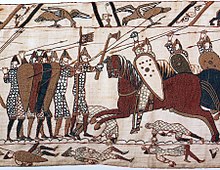
William appears in a scene from the Bayeux Tapestry depicting him at the time of his greatest triumph, the Battle of Hastings.  It is known that he was about five feet ten inches in height, which was tall for the time, and of powerful build.  He also appears to have gone bald early in life.

William the Conqueror, depicted on the Bayeux Tapestry.

William the Conqueror (part 2)

William the Conqueror (part 2)

Duke Robert encountered Herleva and he swore that he would never leave her!

According to legend, Duke Robert was surveying his lands from the battlements of his castle at Falaise.  A glorious scene, he no doubt thought, as his eyes scanned the fertile green fields of his duchy.

Robert 1st, Duke of Normandy (1000-1035).

On this particular day a young woman was washing clothes in the river. Her skirts were hitched high up her legs in order to keep them dry. He marvelled at her beauty and was unable to take his gaze from where she stood in the water. The young Duke was besotted by what he saw and immediately inquired about her name.  He was told that the young woman’s name was Herleva.

Herleva of Falaise.

The invitation which changed the destiny of an entire nation!

Without delay, Robert sent an invitation for Herleva to dine with him at the castle.  Herleva naturally accepted, dinner was divine, and within a short time she was ensconced at Falaise as the ducal mistress.  Robert could not have any idea that the invitation would alter the entire course of England’s history.

A conqueror is born!

A birth that unborn generations would tearfully mourn!

In 1028, Herleva gave birth to a boy, William.  The couple were not married because Herleva was of humble birth. The social protocol of the time forbade the marriage the marriage of a Duke to a commoner. Her father Fulbert appears to have made his living by means which were considered very low down the Norman pecking order. Fulbert was a tanner.

This would have meant working with the hides (skins) of dead animals. Tales of the stench  from the hides in a tannery were infamous. It was said that you could detect a tanner’s presence by his smell from a 20 paces and a scent of this sort permeating the Great Hall at Falaise would have been most unwelcome. So for the time being Duke Robert could not put a wedding ring on Herlava’s finger.

In the meantime Robert decided to make a pilgrimage to Jerusalem but was taken ill on the return journey and died at Nicaea in July 1035. The dreadful news was accompanied by dark rumours of murder by poison.

Duke Robert’s death in a faraway land!

Before he had taken in marriage, fair Herleva’s hand!

Would serve to advance the ambitions of many a traitorous Norman band!

Herleva was naturally keen to see that her son, eight year old William would succeed his father as Duke of Normandy. However not all of the Norman nobility were not about to rally to the aid of this particular damsel in distress.  Duke Robert’s death coupled with William’s youth combined with his illegitimate birth and compounded by the treachery of the barons meant that it was highly improbable that he would ever live to be Duke. Seeing what appeared to be a golden opportunity, a number of nobles conspired to rob the boy of his birthright!

Young William!

‘Boyhood reveals the man as morning shows the day’.

Jesuit axiom.

Clearly William needed loyal adults to ensure his safety. Herleva’s brother, Walter was appointed as young William’s chief guardian. However it soon became clear that any man accepting a post in William’s ducal employment could expect a seriously shortened life expectancy.

A happy childhood!

Of William’s, nothing was good!

One of William’s bodyguard’s, Osborn had had his throat cut while he slept next to the young Duke in his bedchamber.

Any time to educate?

No! Barely a second to evacuate!

William’s tutor was slain as he arrived to teach the boy his lessons. On one occasion, uncle Walter had to rush the boy from his bed as he lay sleeping when a  gang led by a local landowner intent on murder tried to gain entry. William was forced to mount a horse clad only in his underclothes and compelled to cross a fast flowing river in a bid to reach safety.

Normandy descended into chaos with the rival bands attacking each other with unbridled savagery . No one was safe! Friend turned against friend and neighbour against neighbour!

Hear no evil!

See no evil!

Speak no evil!

This was certainly true of one unfortunate Norman noble. The unsuspecting fellow arriving at a neighbour’s wedding feast at a time when hostilities appeared to have ceased was in for an unpleasant surprise! Nuptial festivities? This guest returned home without his ears, eyes and tongue! The noble was given over to to the care of monks, all of whom had taken an oath of celibacy. Our noble friend did not have to worry about celibacy, his host had taken a knife to his sexual organs.

Love thy neighbour?

No! No! Neighbourhood watch!

With neighbours such as these, William had to exercise constant vigilence as he sought to regain his authority. Young William proved himself to be a youth of great courage and resourcefulness by outwitting those who threatened his ascension to the ducal seat.

By the 1050’s, William (often called William the bastard, but never to his face) had defeated his rivals and his position as  Duke of Normandy was secure.


The Battle for the English Crown.

The Battle for the English Crown.

William was now a powerful continental ruler whose power rivalled that of his nominal overlord,  the king of France.  However William had his eyes on a much greater prize.

Eyes on the prize!  William desires to gain lands of a far greater size!

William considered himself to be the heir to his distant cousin, the elderly king of England, Edward the Confessor.  Edward had spent part of his formative years in Normandy and retained an affection for the Norman way of life.  Normans were made extremely welcome at his court and many settled permanently in England.

The Confessor in his younger days.

Edward would die without an heir. An event that would ultimately cause the three greatest military commanders of the era to fight to the death on English soil.

Wise career move!

William was aware that Edward enjoyed the company of Normans, so as a young man he is alleged to have taken the trouble to visit Edward in 1051 in order to become better acquainted.  William and Edward appeared to hit it off really well! So well in fact that William claimed that Edward had promised him the throne of England after his death.  During his latter years, Edward had become preoccupied with the construction of his great church just west of London, ‘the west minster’, that would one day be known as Westminster Abbey. Edward died in January 1066 and William assumed that he would now become king.

William is pipped at the post!

He finds himself rejected by the most!

The most? Yes, the Saxons of England had other ideas! They wanted one of their own to rule over them. Edward appears to have had second thoughts regarding his Norman cousin, because on his deathbed, he declared that Harold Godwinson would be his successor!  

Harold as Earl of Wessex was an experienced ruler and an accomplished soldier.  Indeed the ‘Witan’ , or the body of great nobles which advised the king, selected Harold over William as king.

Harold Godwinson.


Harold was crowned king within days of Edward’s death in the new abbey at Westminster.

Why?

Because as a prospective boss,

The Saxon nobles considered William a dead loss!

William had a reputation of dealing in a very tough manner with people who upset him!

William considered this an outrageous trick!

It was one that made him sick!

He prepares a mammoth invasion

that would mark a momentous historical occasion!

William decided that he would invade England and take the throne by force! He advertised all over Europe for soldiers of fortune to join his army and promised great rewards for those who would be prepared to follow! William gathered his military host at a Norman port in the summer and patiently awaited a favourable wind in order to set sail for England’s southern coast!